Six states earn BNSF’s 2026 Tracking to Zero award for grade crossing safety
By TERENCE CROUCH
Staff writer
Minimizing grade-crossing incidents takes more than just a railroad alone. It requires strong partnerships among railroads, transportation agencies and local communities all working together toward the same goal.
That's the idea behind BNSF’s Tracking to Zero Award, which recognizes state departments of transportation (DOTs) that are helping improve grade-crossing safety across our network. This year, BNSF is proud to honor six states: Alabama, Iowa, Missouri, Montana, New Mexico and Wyoming.
The award recognizes states that averaged fewer than one grade-crossing incident per 1 million BNSF train miles traveled, based on 2025 data reported to the Federal Railroad Administration (FRA). Montana and Wyoming earned the distinction for the third consecutive year, while New Mexico received the award for the second time.
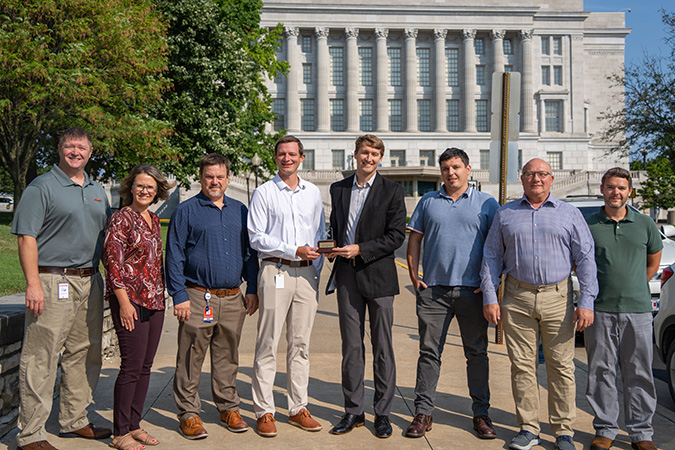
“The success of Tracking to Zero shows that lasting safety improvements happen when partners unite around one common purpose,” said Rich Scott, BNSF assistant director of public projects. “The achievements of these six states set an important benchmark, and BNSF is committed to building on that progress by engaging even more communities in the years ahead.”
Launched in 2024, Tracking to Zero is a first-of-its-kind initiative aimed at reducing grade-crossing incidents across BNSF’s 32,500-mile network, which spans 28 states and three Canadian provinces. Since the program’s inception, the number of states meeting the award criteria has grown each year, highlighting the impact of collaboration between public agencies and the railroad.
This year’s honorees demonstrated their commitment through a variety of safety efforts. Examples include:
-
Eliminating at-grade crossings
-
Constructing grade separations
-
Enhancing crossing signals and signage
-
Researching and piloting new safety technologies
-
Leveraging state and federal funding
-
Supporting community education initiatives
-
Implementing measures to reduce railroad trespassing.
This year’s honorees stood out for innovative approaches to addressing crossing safety challenges.
Missouri: The Missouri Department of Transportation adopted a corridor-based approach to evaluating crossing improvements, studying entire rail subdivisions to ensure projects improve safety across a region rather than shifting risks elsewhere.
Since 2022, MoDOT has conducted engineering studies on multiple rail corridors, including two BNSF subdivisions where crossing improvements are already being implemented.
Missouri also partnered with BNSF and Clark County on projects to replace two aging highway overpasses with modern structures. The effort allowed four nearby at-grade crossings to be permanently closed, improving safety while enabling motorists to cross the rail corridor without interacting with train traffic.
The crossing closures also eliminated the need for train horn use at those locations, reducing noise impacts for nearby residents.
New Mexico: New Mexico has taken a systemwide approach to rail safety by using federal funding not only for traditional crossing improvements, but also for corridor-wide studies that evaluate risks and opportunities across entire rail lines.
The state has also supported crossing closure projects and crossing consolidation efforts, helping advance improvements that eliminate redundant crossings and improve transportation safety.
Montana and Wyoming: For the third straight year, Montana and Wyoming have distinguished themselves as leaders in railroad safety, maintaining an Incident Frequency Rate below 1.0 through a sustained commitment to engineering improvements, employee vigilance, public education and strategic investment in rail infrastructure. "Their continued success reflects a safety culture that extends beyond railroad operations and into statewide partnerships among railroads, transportation agencies, regulators, emergency responders and local communities," said Mary Ann Monaldi, BNSF engineering manager.
Network-wide progress: The work at both the state and local levels contributes to measurable progress across the BNSF system. Between 2024 and 2025, our grade-crossing incident frequency ratio declined 4.5%, reaching its lowest level since 2021. The improvement reflects continued investments in infrastructure, public awareness and partnerships focused on reducing risk where roadways and railroad tracks meet.
BNSF also reached a significant milestone last year, eliminating our 7,000th at-grade crossing since launching a crossing-closure safety initiative in 2000. Removing redundant and underutilized crossings remains one of the most effective ways to improve safety, and transportation agencies across the network continue to be important partners in identifying and advancing those projects.
Grade-crossing safety remains a core part of BNSF's broader safety culture. Because trains require significant distance to stop, preventing incidents often depends on how motorists and pedestrians approach railroad crossings. As a result, long-term safety gains are achieved through a combination of engineering improvements, education, enforcement and collaboration.
These efforts have helped drive meaningful progress over time. Since 1995, BNSF’s rate of grade-crossing collisions has declined 64% per million miles traveled, a result of sustained work by railroad employees, transportation officials and community partners across the network.
As BNSF works toward a goal of fewer than one grade-crossing incident per 1 million miles traveled by 2030, the Tracking to Zero program continues to spotlight the partnerships helping make that progress possible. The accomplishments of Alabama, Iowa, Missouri, Montana, New Mexico and Wyoming demonstrate the impact of a shared commitment to safety and help move us closer to our ultimate safety vision of zero accidents.